


To listen to an audio of this article, click the link
In 2024, we made a deep investigation into Iran which combined data analysis and human-centered analytics to identify the resiliency of the Islamic Republic, as well as domestic resistance to it. It followed a process spelled out through years of research in our book Resilience and Resistance (Joint Special Operations University Press, 2025). Our essay evaluated state fragility, governance challenges, and specifically identified resistance movements.
Our conclusion argued that Iran’s regime is fragile and that external support for reform movements could prove important for change.
You can find our Iran article here.
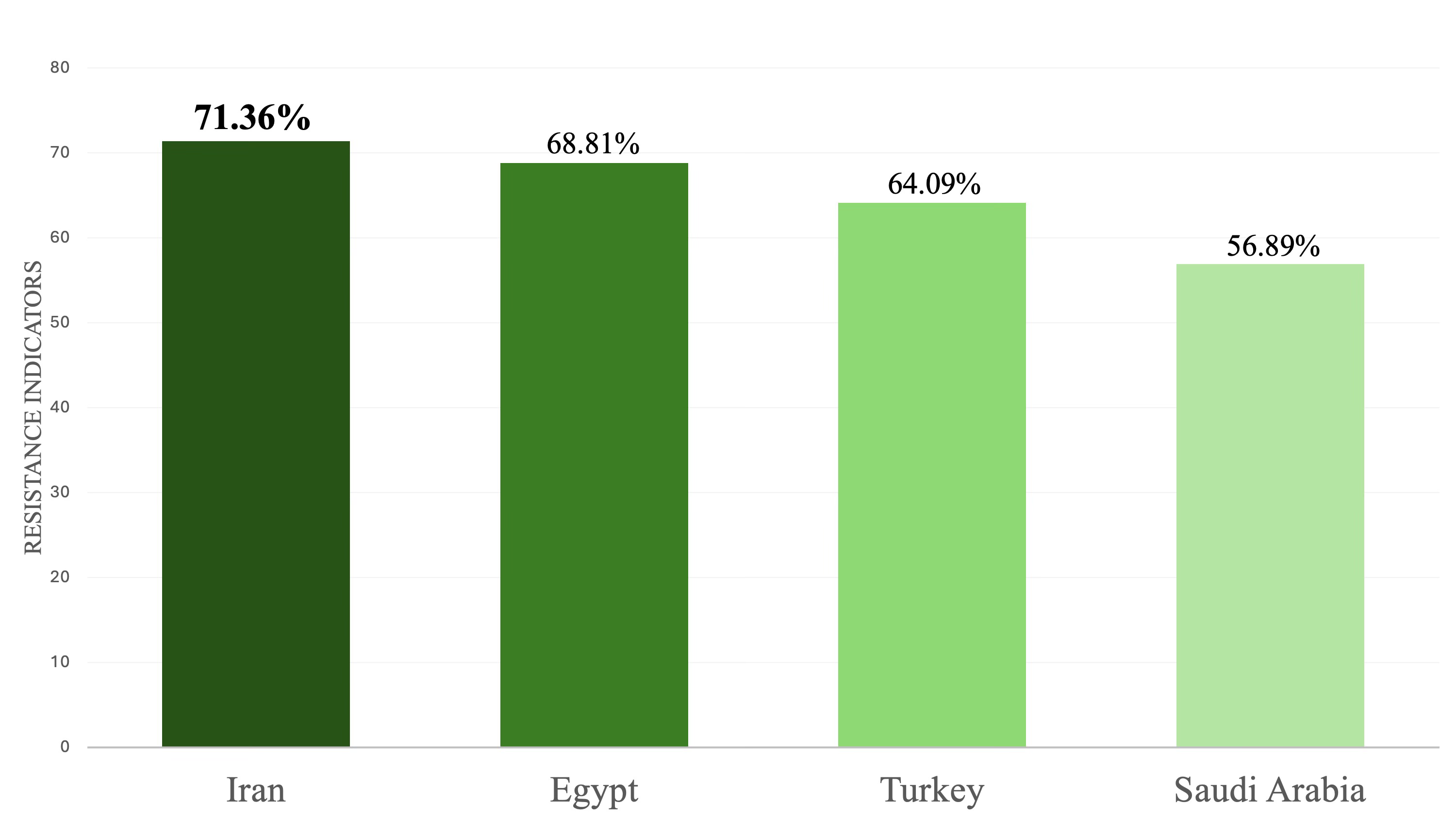
We assessed that Iran contains explosively high resistance energy relative the other regional Islamic hegemonic nations (see Figure 1). Most of this energy derives from the ingroup of Persians who generally utilized nonviolent methods of mobilizing and attempting to bring about change. The first major wave of nonviolent protest manifested itself as the Green Path of Hope in 2009. The second wave occurred with the Women, Life, Freedom movement, crystallized following the murder of Mahsa Amini in 2022 for not fully tucking her hair into her hijab. The third and most recent massive wave of protests is driven by economic depravity and currency collapse, political repression and corruption, and poor governance.
The public demand for a new representative government commenced in December 2025 and resulted in an extremely violent government response. The Islamic Revolutionary Guard Corps (IRGC), Basij militia, and police opened fired on the people resulting in the massacre of over 30,000 citizens.
The killing prompted an immediate escalation of popular resistance and the movement quickly progressed right into riots, as seen on the resistance continuum as a nonviolent/illegal protest (see Figure 2). By February 2026, there was broad agreement within the U.S. intelligence community that the Iranian theocratic republic was at its most vulnerable condition since its conception during the 1979 Revolution. The weakening governmental resilience and strengthening popular resistance enhanced the efficacy of a military option to finally eliminate the Iranian threat and achieve regional peace and stability. This resulted in the combined U.S.-Israeli operation Epic Fury.
The United States has outlined several Epic Fury operational objectives; destroy and dismantle Iranian ballistic missile capabilities, neutralize the Iranian Navy, eliminate Iranian nuclear weapons capabilities, and degrade Iranian proxy network capabilities. The ultimate outcome is to eliminate the Iranian threat to U.S. citizens around the globe.
Though not explicitly stated as a strategic objective, the President is urging the Iranian people to rise-up and force a regime change. A new representative government would greatly benefit the Iranian people and could completely reshape the Middle East with a long-term trajectory toward lasting peace.
Operation Epic Fury is proceeding ahead of expectations and has decimated the totalitarian leadership of Iran, as well as its conventional military power. Their military apparatus is showing clear signs of rapid decline and desperation; ballistic missile activity is significantly reduced and uncoordinated, capital Iranian naval vessels are sunk, drone attacks are sporadic, and threats to sea lines of communication are nominal. The absence of centralized command, control, and extensive deterioration of capability presents an opportunity to empower the resistance movement and further weaken regime resilience to reach a decisive tipping point.
Continued U.S.-Israeli military operations combined with heightened global economic and political pressures may foster enough government fragility for Persians to seize control and force an enduring change.
Epic Fury, however, has some inherent risks.
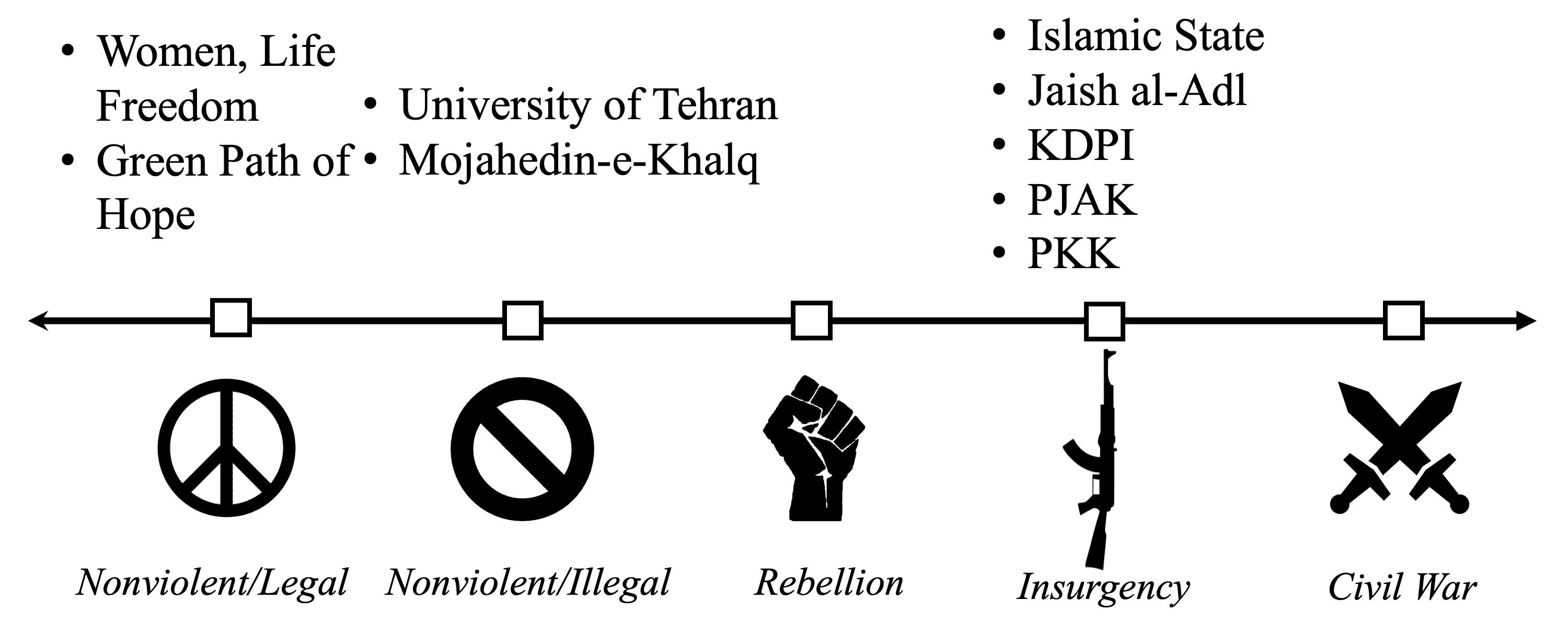
The ethnically and ideologically diverse peoples in the country could fracture along historical fault lines resulting in a revival of insurgent groups who seek more autonomy (see Figure 2). This includes (1) Jaish al-Adl, a Sunni militant group of Baloch ethnicity in Iran’s south-eastern Sistan and Baluchestan Provinces; (2) Democratic Party of Iranian Kurdistan (KDPI), a Kurdish underground and militant group; (3) Kurdistan Free Life Party (PJAK), another Kurdish militant group; and (4) Kurdistan Workers Party (PKK), another Kurdish militant and politically-socialist group.
These separatist groups possess significant military capabilities that may supplant the popular movement which lacks such capability. However, there is a potential to merge these groups into a collective uprising with a clear path to a representative government for the greater good. Organizing such an effort will require new credible leadership, trustworthy arbitrators, considerable concessions, and time. The ultimate result must be achieved by the Iranian people themselves.
Bottom Line. Thus, the situation in Iran could prove quite tenuous and complex. As Epic Fruy progresses, the goal of breaking the grip of Iran’s current totalitarian regime might accomplish that. However, it could also unintentionally result in intrastate conflict with dynamic, fluid, and convoluted violence. U.S. and Israeli policymakers and joint military planners must consider all these possibilities and navigate the dynamic situation using all instruments of national power, while consistently reevaluating the popular resistance energy and governmental resiliency in the human domain.
Current euphoria over the death of the hated dictator Ayatollah Ali Khamenei, both domestically and abroad within the Iranian diaspora, could certainly push the movement to the tipping point with a continued measure of external pressure and support.


