


To listen to this full article, click the play button above.
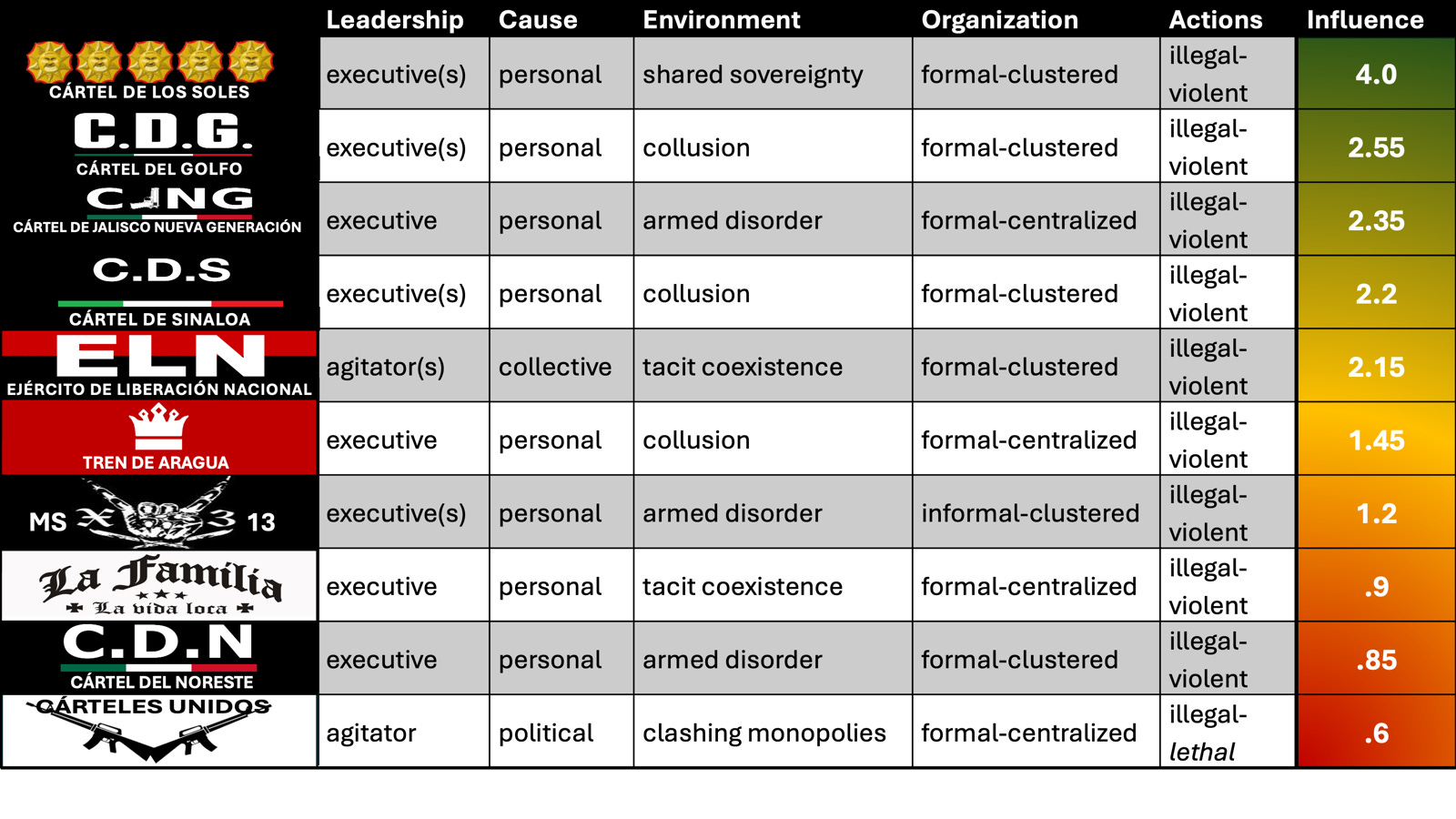
Welcome back as I delve further into U.S. designated foreign terrorist organizations in Latin America. This time, Cártel del Golfo (CDG) in Mexico. This case study illustrates the significance of the Actor Index, as it evaluates the influence of Latin American transnational criminal organizations in comparison with others. In this instance, the CDG is assessed as slightly more dominant than widely recognized organizations such as the Cartel del Sinaloa and the Cartel del Jalisco Nueva Generación.
Since the 1930s, CDG has maintained a presence in the cities of Matamoros and Reynosa - in a region dominated by the flow of illicit good. The organization is divided into factions known as Los Metros, Los Ciclones, and Los Escorpiones. This results in unpredictable unified actions; however, its smuggling operations remain robust due to their decentralized nature.
One of the oldest cartels, CDG was founded by Juan Nepomuceno Guerra, who bootlegged into the U.S. during its prohibition era. Today, one prominent member of the cartel includes Juan Reyes Mejía-González, who is wanted for drug trafficking by State Department, with a reward of $5 million. However, the organization remains collectively grouped into loosely aligned factions. Consequently, leadership behaves as business-oriented executives. While most members have Mexican roots, Mexican citizenship does not appear a requirement. For instance, the organization includes limited US and Guatemalan members.
CDG wields an extensive underground, utilizing secretive tradecraft to maintain concealment. It also maintains a significant armed component to defeat its rivals, and an auxiliary to facilitate illicit manufacturing and transportation functions. Leadership derives from current membership and is not recruited.
The cartel offers an alternative to the state through shadow economics. The fundamental component to member motivations centers on personal profit. However, improved social status is also important.
It operates along the eastern coast of Mexico, specifically in the Gulf states of Tamaulipas, Nuevo León, San Luis Potosí, Veracruz, and Jalisco. Its geographical location enables the trafficking of narcotics from South and Central America into the United States. Operations in these strategic crossroads requires either agreements or violence with other TCOs. To its south, the cartel currently collaborates with Cartel del Jalisco Nueva Generation, while it faces competition from Cartel del Noreste and Cartel de Sinaloa to the north and west. Historically, CDG ‘s relationship with the Mexican government has been characterized by collusion, although it has occasionally led to instances of armed conflict.
CDG resembles a formally clustered organizational model characterized by a strict allocation of roles and positions, yet it does not have a singular leader identified. This indicates that the death or imprisonment of its leadership could result in further fragmentation. Conversely, CDG has unified in the past to confront external threats.
Its activities encompass narcotics trafficking, money laundering, extortion, kidnapping, human trafficking, robbery, murder, arms trafficking, bribery, and counterfeiting. CDG favors nonviolent and nonlethal methods in its illegal business operations; however, it resorts to violence and lethal measures for intimidation purposes and to uphold regional boundaries.
As depicted in Figure 2, the impact of CDG continues to be significant in the realms of political, security, and financial aspects, while intentionally remaining minimal in the area of information to uphold a discreet presence, culminating in an overall score of 2.55 out of 4. As such, CDG is rated as the most powerful transnational criminal organization in Mexico, slightly higher but comparable with the Jalisco Cartel and the Sinaloa Cartel.
If you’re interested in reading the working paper published by myself and my teammate Manuel Carranza on the Actor Index, its available via this link.
Going forward, stay tuned for my next video on U.S. designated terrorist organizations in Latin America as we look at an important and unique resistance organization in Mexico by the name of Cárteles Unidos. If you liked this video, please like and/or leave a comment below.
Cheers,


