


To listen to the audio version of this article, click the play button.
Welcome back as I delve further into U.S. designated foreign terrorist organizations in Latin America. This Mexican criminal organization operates primarily from the state of Michoacán. Michoacán is famous for its agriculture, particularly avocados and limes.
Cárteles Unidos is often referred to as La Resistancia. As the name implies, this organization was built as an alliance of soldiers and firepower from several cartels. As of 2025, it includes Cártel de Tepalcatepec, Los Viagra, Los Caballeros Templarios, Los Blanco de Troya, and La Nueva Familia Michoacana. In the past, it also included Blancos de Troya, Cartel del Golfo, Milenio Cartel, and even the Sinaloa Cartel. At its heart, Cárteles Unidos is akin to a militia or paramilitary group, focused on the establishment and utilization of an armed component to protect the state of Michoacan from incursions and influence by Cartel del Jalisco Nueva Generación. As a relatively small entity, its classification as a foreign terrorist organization by the Trump administration prompts questions regarding the rationale behind why it was designated as such. One reason may derive from the collective power it represents.
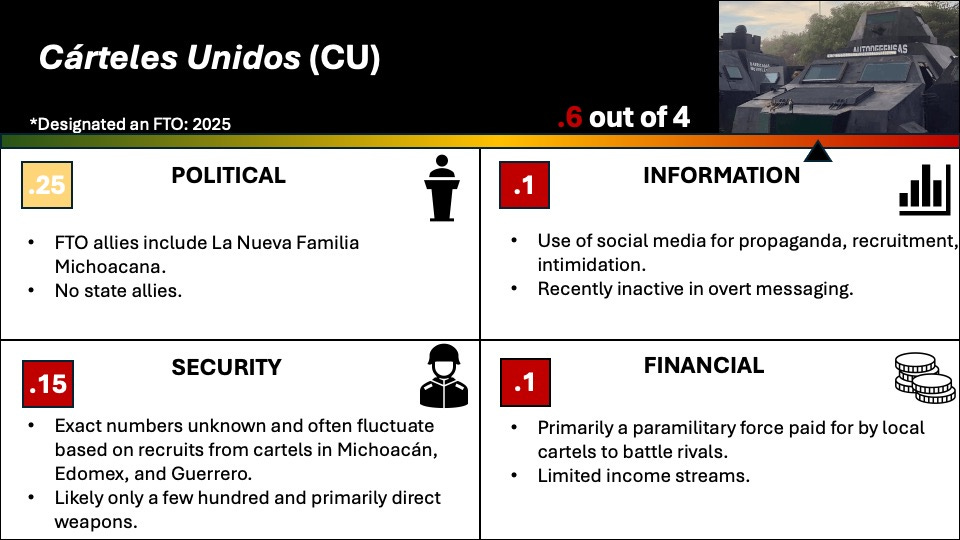
A defensive alliance of local autodefensas, Cárteles Unidos has organized, reorganized, and adapted its resources in direct response to the threat presented by the Cártel del Jalisco Nueva Generación. One possible reason for the designation of Cárteles Unidos is that violence direct at the Jalisco Cartel has been linked to spilling over onto Mexican security forces. This is exemplified by a booby-trap improvised explosive device which killed two soldiers and wounded five others in Michoacán in December 2024. As illustrated in this figure, Cárteles Unidos influence is fairly low, due primarily because of its existence solely as an armed organization. It is rated as .6 out of 4 possible.
The leader of Cárteles Unidos is Juan José Farías Álvarez. He acts as an agitator of the organization – inspiring local actors in Michoacán to resist Cártel del Jalisco Nueva Generación. This group mainly possesses an armed faction but also operates an underground network for security. Membership and leadership are primarily sourced from within the Michoacán state.
The objective of Cárteles Unidos centers on the expulsion of their adversary from the region in order to perform illicit activities without obstruction. While personal motivations may include increased social standing, the members primarily act as mercenaries for monetary gain. Their collective application of violence is utilized for the advantage of the member organizations. The defense alliance enables Cártel de Tepalcatepec, Los Viagra, Los Caballeros Templarios, Los Blanco de Troya, and La Nueva Familia Michoacana to maintain their illegal enterprises.
Cárteles Unidos was created and organized specifically to address the clashing monopolies of two nonstate actors. Simultaneously, it generally attempts to live in tacit coexistence with the local and regional government forces. Cárteles Unidos and the Mexican government arguably share a similar goal in halting the growth and influence of the Jalisco Cartel. However, Cárteles Unidos does not appear to have coopted tacit coexistence with the state.
This cartel attempts to behave as a formal and centralized model to harness and employ the maximum firepower of its members and resources. For instance, specific roles in the organization are certainly assigned and formal. But while it attempts to resemble a structured military organization tactically, in practice, it also operates on a larger level based on consensus-based-decision-making. This is illustrated by the rotating members in the coalition over time. Such dynamics result in a formally clustered model, similar to a tribal framework. Although principally designed to execute violence, it has attempted to promote those activities to facilitate recruitment, build public trust, and intimidate competitors; however, the scope of its information component is fairly limited.
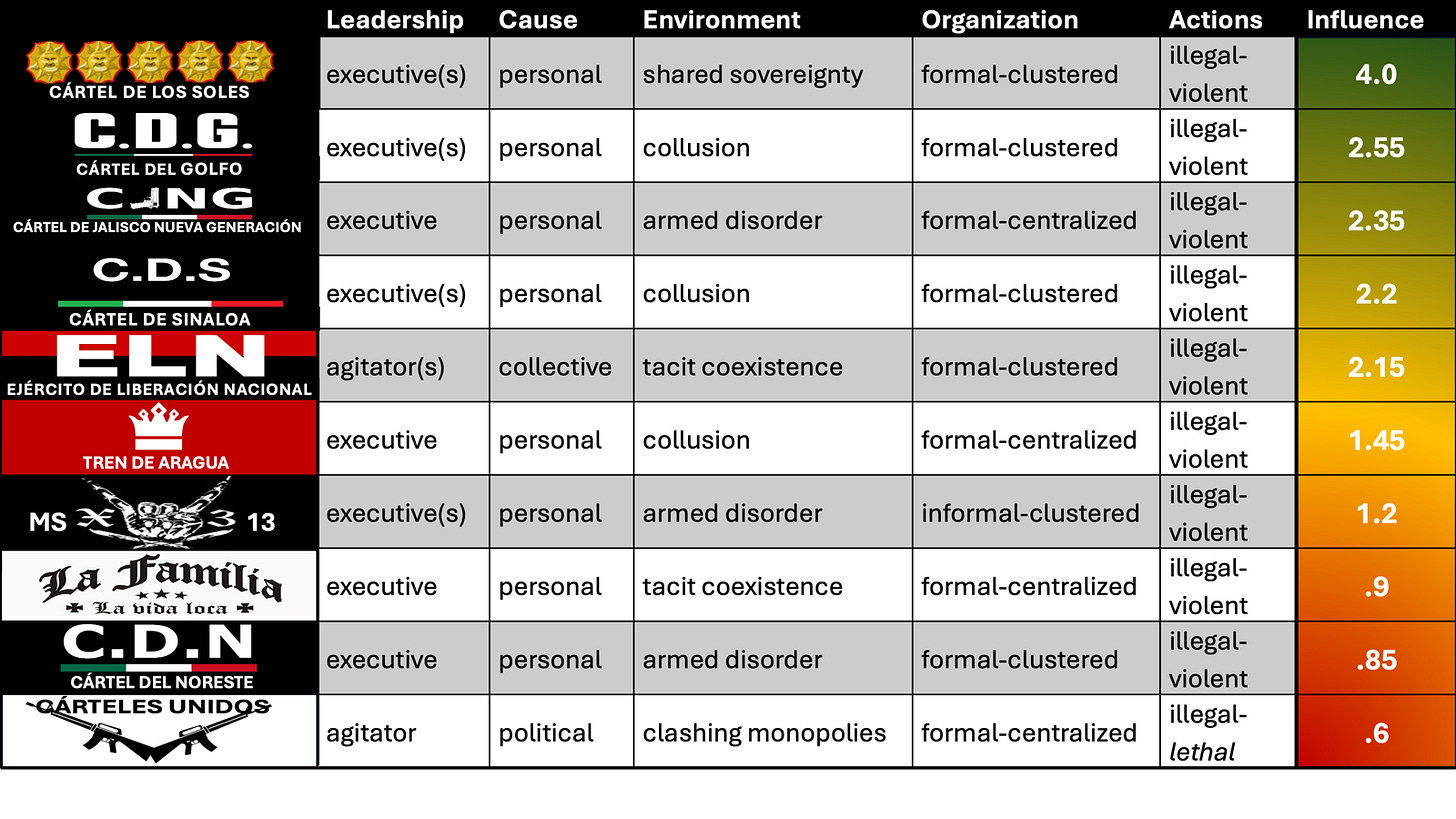
The strength of Cárteles Unidos remains political, as it harnesses the efforts of numerous other organizations. However, as illustrated in this figure, Cárteles Unidos remains limited as a singular entity, because it does not self-finance or control its own narrative in many respects. This makes it one of the least influential foreign terrorist organizations in Mexico.
For more information, you can check out the working paper published by myself and my teammate Manuel Carranza via the link.
Going forward, stay tuned for my last video on U.S. designated terrorist organizations in Latin America as we look at La Nueva Familia Michoacana.
If you liked this video, please like and/or leave a comment below.
Cheers,


