

To listen to an audio version, click the link below.
I recently joined with Lieutenant General (retired) Charles Cleveland to give an interview about our new book Resilience and Resistance (Joint Special Operations University Press, 2025).
Click here for the book.
A synopsis of my talking points follow. For the Irregular Warfare Initiative podcast click here.
A Textbook for Irregular Warfare
I wrote the book while teaching irregular warfare (IW) at Joint Special Operations University because there was no comprehensive guide on how to do it. The U.S. and DOD viewed irregular warfare as either confined to low-intensity conflict or everything that wasn’t traditional war between two states. The resulting confusion and lack of consensus made it difficult to understand this type of conflict as well as its relationship with deterrence, competition, and traditional warfare. I set out to reframe IW’s place, demonstrating how it overlaps with other forms of conflict, but remains distinct as a kinetic form.
Intrastate Conflict: Highest Peek in Human Memory.
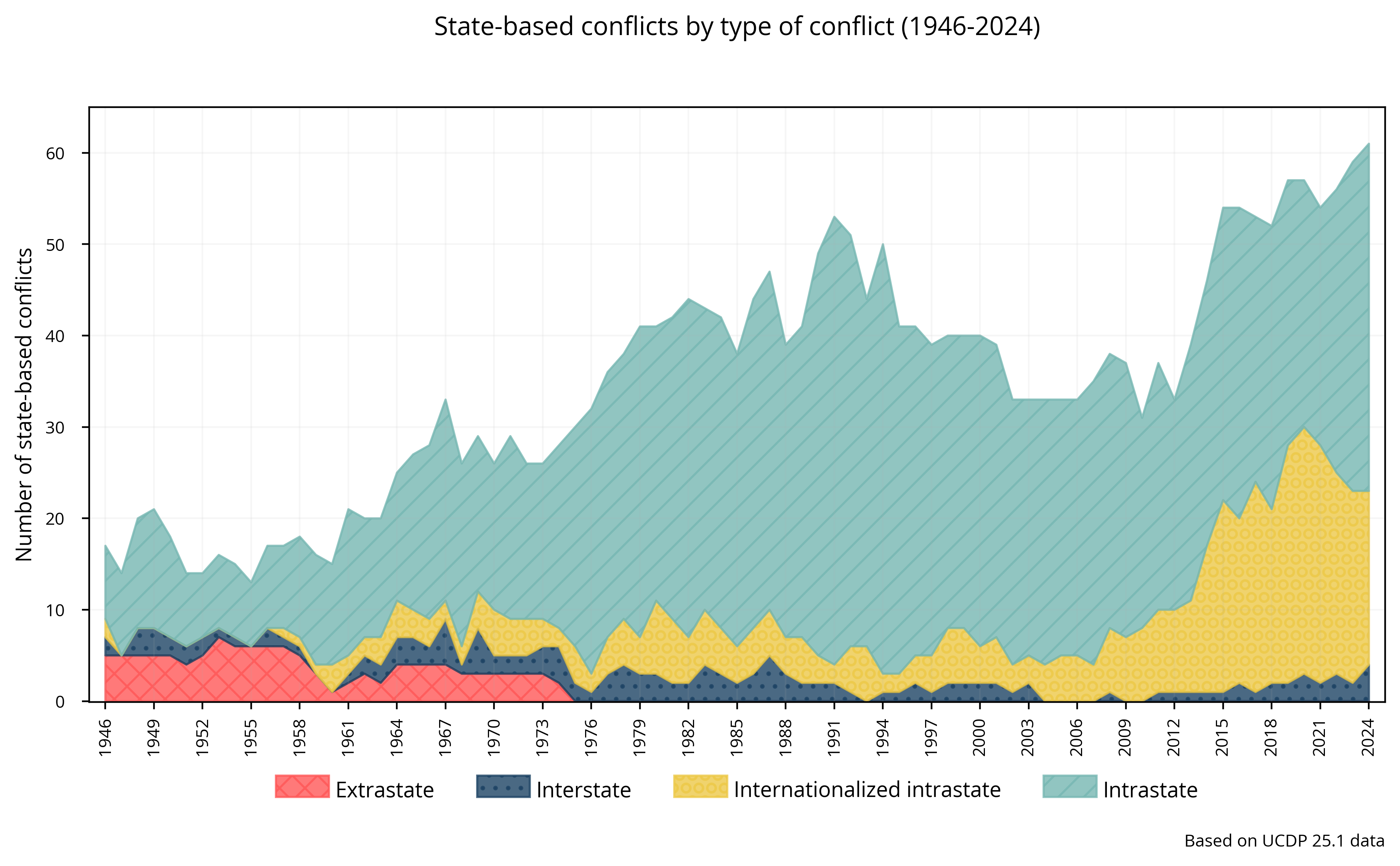
Unfortunately, the world appears in a dire crisis right now with longlasting national security implications for the United States. There are 59 nation states currently struggling with violent intrastate conflict, with 90 others supporting either current forms of governance or the resistance organizations seeking change. About 25% of the world’s population lives in these conflict zones. Adversaries like China, Russia, and Iran are actively involved, while the U.S. and its allies appear unable or unwilling to address the threats. This book offers insights into how to better evaluate intrastate conflict in a way that facilitates more effective U.S. partnerships abroad.
The Resilience and Resistance Model
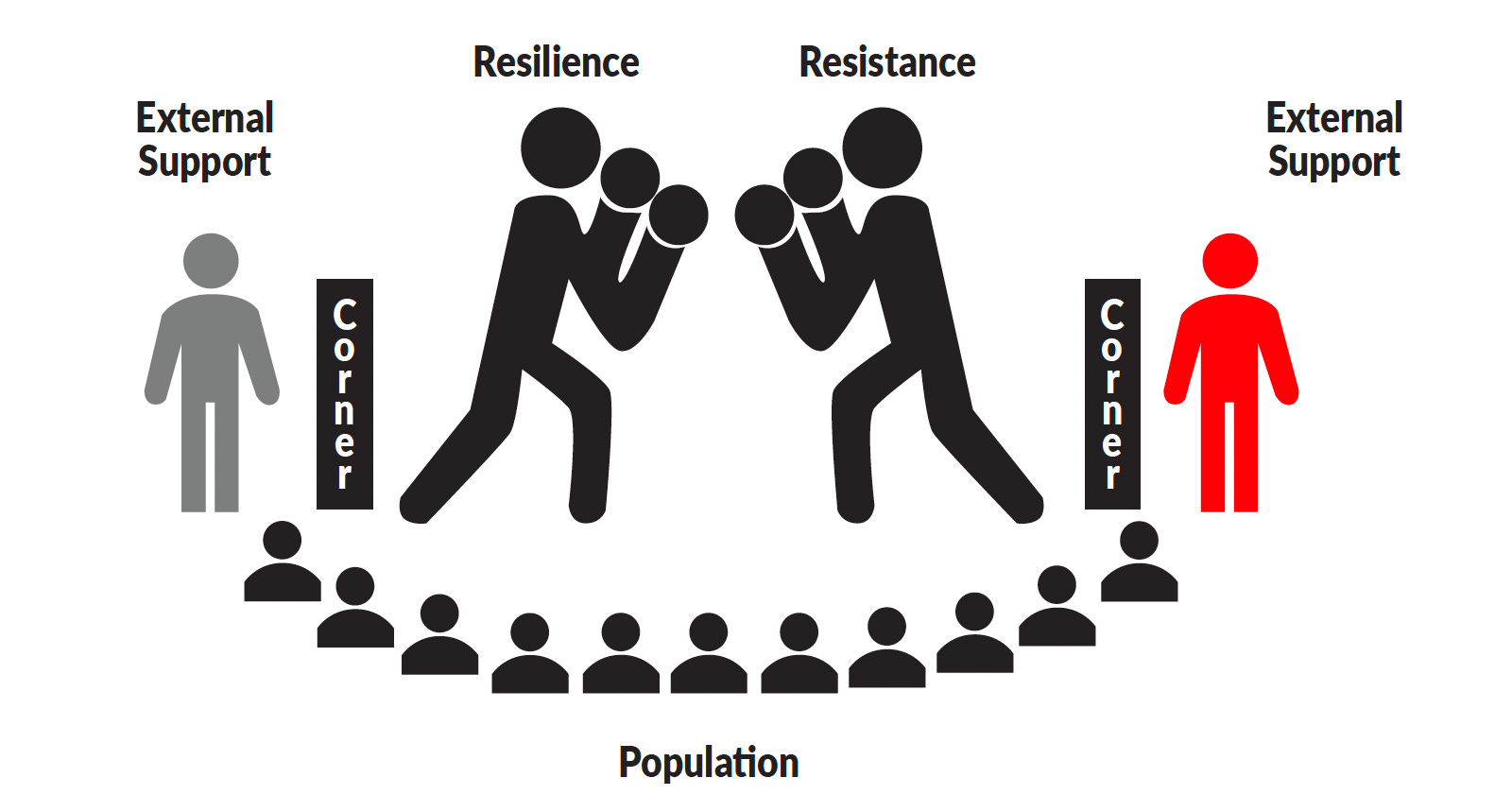
Boxing was one of the analogies I used to describe the interplay occurring within the resilience and resistance model. In the ring, resilience (the established power) works to absorb shocks, maintain legitimacy, and endure, while resistance (the challenger) seeks to disrupt and change the status quo. External actors provide support from the corners, internationalizing the conflict. The population acts as spectators whose support shapes legitimacy for either side. This dynamic applies to every society as a yin-yang polarity between governance and opposition to it.
Defining Resilience and Resistance
Resilience is more than state capacity. It is the system’s ability to handle pressure, adapt effectively, and maintain legitimacy under stress—encompassing governance effectiveness, social unity, and public confidence. A state can have strong capacity but still lack resilience if it fails on legitimacy or adaptability.
Resistance exists on a continuum with distinct categories and natures: peaceful protest (e.g., Martin Luther King), illegal protest (e.g., Harriet Tubman’s Underground Railroad), rebellion (small, containable violent flash-ups against humans), insurgency (requiring military response), and belligerency (civil war, with state-like features).
Preparation of the Environment: An Imperative
We must prepare the environment in many states continuously by assessing both governmental/societal resilience and the opposing resistance energy. This informs contingency plans, as well as foreign policy, so we can quickly decide to bolster resilience or support resistance when needed. It is simply not possible to jump into a conflict last-minute; we need planners, human contacts, and knowledge of conflict levers in advance.
The Relationships of Conflict Types
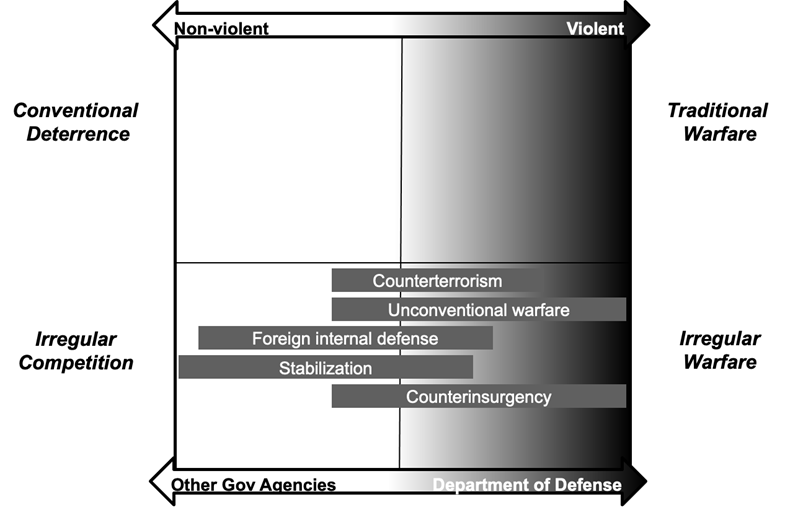
IW is warfare and kinetic in nature. Meanwhile, the DOD’s non-kinetic definition does not make sense in English lexicon. However, forms of irregular warfare, like counterterrorism, counterinsurgency, unconventional warfare, stability activities, and foreign internal defense, also take place during irregular competition.
There is also a form of irregular deterrence. Resistance strategies, like national resistance operating concepts (e.g., Baltic states, Taiwan), can deter by promising costly, protracted conflict. However, success requires patience, careful support types, and realism about external aid.
Key Shifts Needed
The United States should recognize the ongoing geopolitical crisis in political violence; reframe persistent engagement and contingency planning around influencing resilience and resistance worldwide; and treat IW and competition as continuous (not episodic like conventional war). We need whole-of-government structures, long-term patient strategies, and better organizational memory for local knowledge and relationships.
I’m very grateful for the interview by Alexandra Chinchilla and Kyle Atwell !
I must also mention great appreciation for General Cleveland and his continued support of the project, as well as the other academics and practitioners who contributed to this book, including John Collison, A. Jackson, David Oakley, Brian Petit, Chris Mason, John H. Mongan, David DiOrio, Thomas A. Marks, Aaron Baty, Gabriele Pierini, Christopher Marsh, David Maxwell, Namrata Goswami, and the editorial team at JSOU Press, led by Melanie Casey.
Again, to listen to the podcast, click here.
Cheers,


