

On 10 April, I published an article “Is the 2026 Iran War Over?” I used conflict data from Uppsala University in Sweden and the Peace Research Institute Oslo to predict that the initial peace talks in Pakistan with Vice President JD Vance had very little chance of success.
Four months have passed since my initial assessment. This hindsight provides an appropriate opportunity to revisit the data and see if it still stands up, as well as to see how the situation has developed.
The April 2026 Assessment
Analysis of the Uppsala University conflict dataset provides a useful baseline for assessing negotiated conflict termination. The dataset includes 374 conflicts observed between 1975 and 2021. Of these, 134 ended in a mutually accepted and formally signed peace agreement, while the remaining 240 remained ongoing, unresolved, or suspended. Thus, only 35.8 percent of the conflicts examined culminated in a negotiated peace agreement, and even these agreements did not necessarily produce lasting peace. Among those conflicts that ultimately achieved a lasting negotiated settlement, hostilities continued for an average of approximately 598 days before a meaningful peace was achieved.
In contrast, the Peace Research Institute Oslo Civil Conflict Ceasefire Dataset draws upon the UCDP conflict data. It assesses 2,202 ceasefires between 1989 and 2020. The findings illustrate the limited durability of ceasefires as mechanisms for terminating conflict. Most do not produce a complete cessation of hostilities, with some level of sporadic violence continuing after an agreement is reached. Ceasefires are also generally short-lived, lasting an average of only ten days, while individual conflicts experience a median of twelve separate ceasefires (and a mean of 20). Most significantly, only 7.2 percent of ceasefires ultimately result in a formal peace agreement.
Based on these metrics, I determined a lasting peace highly unlikely.
Changes Through August 2026
Several military and political changes have taken place over the past four months. The Iranian regime leadership has solidified under Mojtaba Khamenei. Recent reports indicate that he has reshaped the military and security apparatus of the country through key appointments. Additionally, the extremists in the Islamic Revolutionary Guard Corps (IRGC) has gained substantial influence over the future direction of Iran. The IRGC has been subjected to terrorist designations and related legal restrictions by the United States, European Union, Canada, Australia, and other governments.
The geographically important Strait of Hormuz remains essentially closed to normal commercial traffic, both from Iranian restrictions on passage and the United States' naval blockade of Iran. This disruption of crude oil traffic has significantly driven oil prices higher. As of 19 August, Brent crude was trading at approximately $91 per barrel, near a three-week high. The disruption is contributing to inflationary pressures, higher borrowing costs, and concerns about slowing global economic growth.
Additionally, regional ties appear to be shifting. Saudi Arabia has signed the Makkah Joint Defence Agreement with Pakistan and Turkey. Reminiscent of the collective-defense arrangements that preceded World War I, this agreement provides that an attack on one is an attack on all. This emerging alignment increases the strategic importance of the separate security relationships among the UAE, the United States, and Israel. At the same time, Iran appears increasingly isolated within the region.
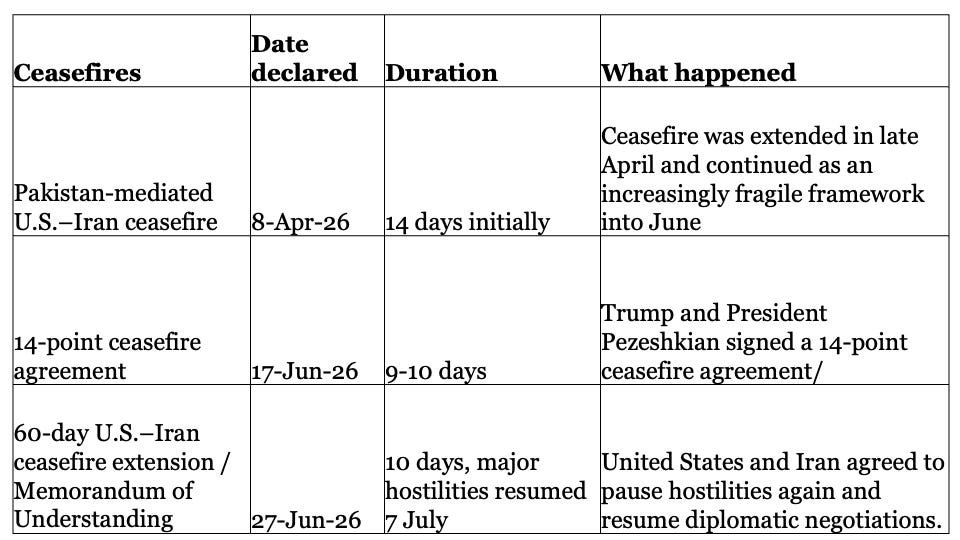
Meanwhile, there have been three major ceasefires in the 2026 Iran War, with disappointing results. These are indicated in the table below.
What History Tells Us About Ending Wars
Peace Research Institute Oslo research found that armed conflicts experience a median of twelve ceasefires, suggesting that repeated cessations of hostilities are not necessarily evidence that a conflict is approaching its conclusion. The Uppsala University data provide another useful benchmark, with negotiated peace agreements occurring after an average of 598 days of hostilities. By comparison, the Iran War is currently only on Day 173 and has already experienced three ceasefire arrangements.
When examining this data, the historical patterns suggest that the repeated ceasefires are indeed normal, but also that the conflict remains relatively early compared with the historical timeline for most that were ultimately resolved through negotiated settlements. Rather than indicating that peace is imminent, the current pattern of ceasefires, renewed hostilities, and further negotiations suggests that a durable settlement may remain some distance away.
Is Peace Any Closer?
Historically, only about a third of conflicts end in lasting peace. There is therefore no historical basis for assuming that the Iran War will necessarily conclude with a negotiated settlement. When conflicts do reach a lasting negotiated settlement, however, the historical data indicate an average of 598 days of hostilities prior to such an agreement. Consequently, if the 2026 Iran War follows this historical pattern, a durable settlement may not emerge until October 2027.
While I love data to quantify and add weight to arguments, the specific context of the current conflict remains critical to understanding the 2026 Iran War’s trajectory. Unlike most conflicts, the Iran War has significant regional and global implications because of its effects on crude oil production and availability. This pressure on national economies means that every nation has a vested interest in bringing the conflict to an end. These extraordinary external pressures make an eventual negotiated settlement considerably more likely than the historical baseline would suggest, but they do not necessarily mean that such an agreement will occur quickly.
What do you think?
Post a comment below.